
The word is scary. The screening is not.
An oral cancer screening is Dr. Sison looking carefully at the soft parts of your mouth for about two minutes. It is already part of every exam at mend. No needles, no cost, and almost always nothing to find. That "almost" is why we never skip it.
- 2 min
- is all it takes
- $0
- included in every exam
- 0
- needles, instruments or prep
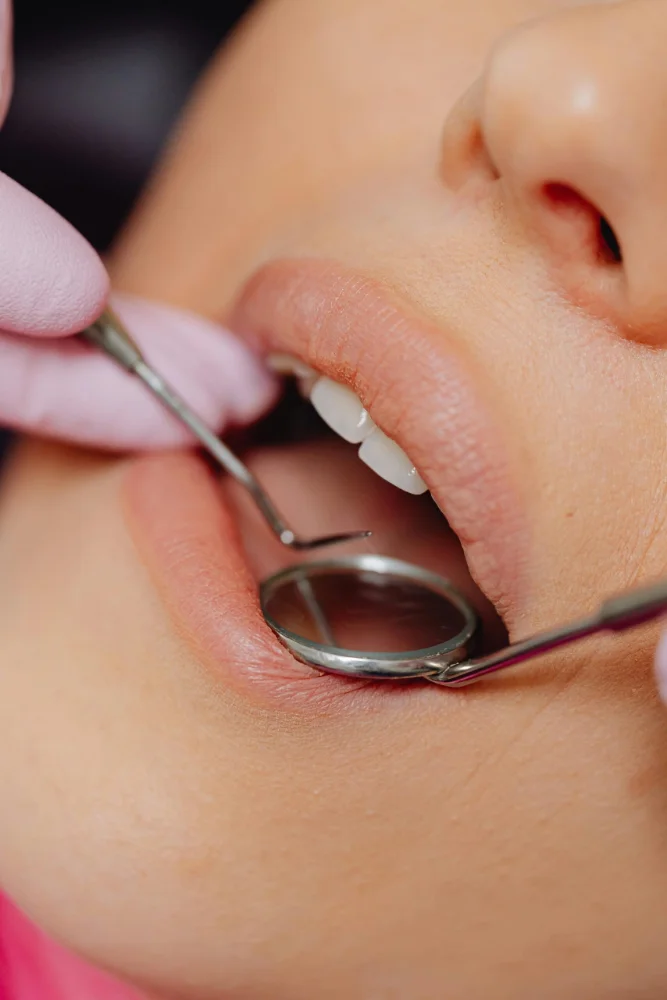
Two minutes of looking. That is the whole thing.
You will barely notice it. Somewhere between the cleaning and the exam, Dr. Sison asks you to say "ah," moves your tongue gently to one side and then the other, and looks under it. She checks the inside of your cheeks, the roof of your mouth, your lips and your throat. Then she feels along your jaw and neck with her fingertips.
She is looking for anything that does not match the other side: a patch that is whiter or redder than it should be, a sore that has not healed, a small lump. That is it. No instruments beyond a light and a mirror, nothing to prepare for, nothing to feel afterward.
- 1Lips and cheeks. A look at the inside of your lips and the lining of your cheeks.
- 2Tongue, top and underneath. Say "ah," then she gently moves your tongue side to side with gauze.
- 3Roof, floor and throat. A light and a mirror, nothing else.
- 4Jaw and neck. Fingertips along the jawline and neck for anything that feels different.
"Can we skip that part?" We understand the question.
Nobody wants to hear the word cancer at the dentist. But the screening is not a diagnosis, and it is not a prediction. It is a look. The only thing skipping it changes is whether something small gets seen while it is still small.
Figures are general, published estimates from the American Cancer Society and the Oral Cancer Foundation, not predictions about any individual.
Most of what we see is nothing.
Mouths are busy places. Bite marks, canker sores, a rub from a sharp filling. When Dr. Sison points something out, this is usually how it goes.
- 1 She tells you, plainlyWhere it is, what it looks like, and what she thinks it probably is. No alarm, no jargon.
- 2 We take a photo and a noteSo we have something to compare against, and so nothing depends on memory.
- 3 We look again in two weeksMost irritations heal within 14 days. If it has cleared up, that is the answer, and there is nothing more to do.
- 4 If it has not, we refer youTo an oral surgeon or specialist who can take a closer look. A referral is a precaution, not a diagnosis. Dr. Sison calls ahead and stays in the loop.
Worth a call if it lasts more than two weeks.
You do not need to inspect your mouth. Just know the handful of things that are worth mentioning if they stick around. Calling is free and we would rather look at ten harmless spots than miss one.
- A sore or ulcer that has not healed in two weeks
- A white or red patch inside the mouth
- A lump or thick spot in the cheek, lip or neck
- Numbness or tenderness in the mouth or lip
- Trouble chewing, swallowing or moving the tongue
- A hoarse voice or sore throat that lingers
Part of every checkup
"I went for a regular checkup, the X-rays were done nicely and they have 3D tech that helps view the teeth in great detail. Dr. Monique explained the problem clearly, calmly and in an easy to understand manner."
 Google review
"Love that I'm greeted by my name, and no matter how much work is being done on me, I don't feel like I'm just a number!"
Google reviewScreening questions, answered.
Related: Cleanings & exams · General dentistry · X-rays & 3D scans